A fixed asset management program is software that records every long-term asset a company owns, tracks where it is and who holds it, and calculates its depreciation until disposal. A good asset register tool replaces spreadsheets with one register linked to tags, audits and the general ledger. This guide compares 6 tools on depreciation, RFID and QR tagging, audit workflows and price. We checked each vendor's own pricing page.
Which is the best fixed asset management software in 2027?
There is no single best tool: 3 of the 6 publish prices, and each fits a different asset base. The table ranks each tool by the buyer it suits.
| Tool | Best for | Listed starting price | Tagging |
|---|---|---|---|
| 1. aTraket (YoByTech) | Indian multi-branch enterprises and utilities | Quote on request | Barcode, QR, RFID |
| 2. Asset Infinity | Mid-sized firms wanting one register | $130/month for 500 assets | QR, RFID |
| 3. EZOfficeInventory | Teams tracking checkouts | $81.41/month for 500 items | Barcode, QR, RFID (Advanced) |
| 4. Asset Panda | Public sector and education | Quote on request | Barcode, QR |
| 5. Tracet | Firms wanting tagging services too | Quote on request | Tagging as a service |
| 6. Snipe-IT | IT hardware and licences | Free (self-hosted) | Asset tags |
What is fixed asset management software?
It is a system that holds the fixed asset register and keeps it in step with the physical assets on the ground. It links each asset's tag, location, custodian, cost and depreciation in one record.
A fixed asset management system usually covers 6 stages of an asset's life:
- 1Acquire: match the purchase order and invoice, then tag and register the asset.
- 2Assign: record the department, cost centre and custodian.
- 3Audit: scan tags in a physical verification and reconcile against the books.
- 4Maintain: schedule preventive maintenance, AMCs, warranties and insurance.
- 5Depreciate: run monthly or year-end depreciation into the ledger.
- 6Retire: approve write-off, record salvage value and remove the asset.
What are the best fixed asset management tools?
The 6 best fixed asset management tools for 2027 are aTraket, Asset Infinity, EZOfficeInventory, Asset Panda, Tracet and Snipe-IT. Each section gives the tool's fit, standout features and listed price.
1. aTraket by YoByTech
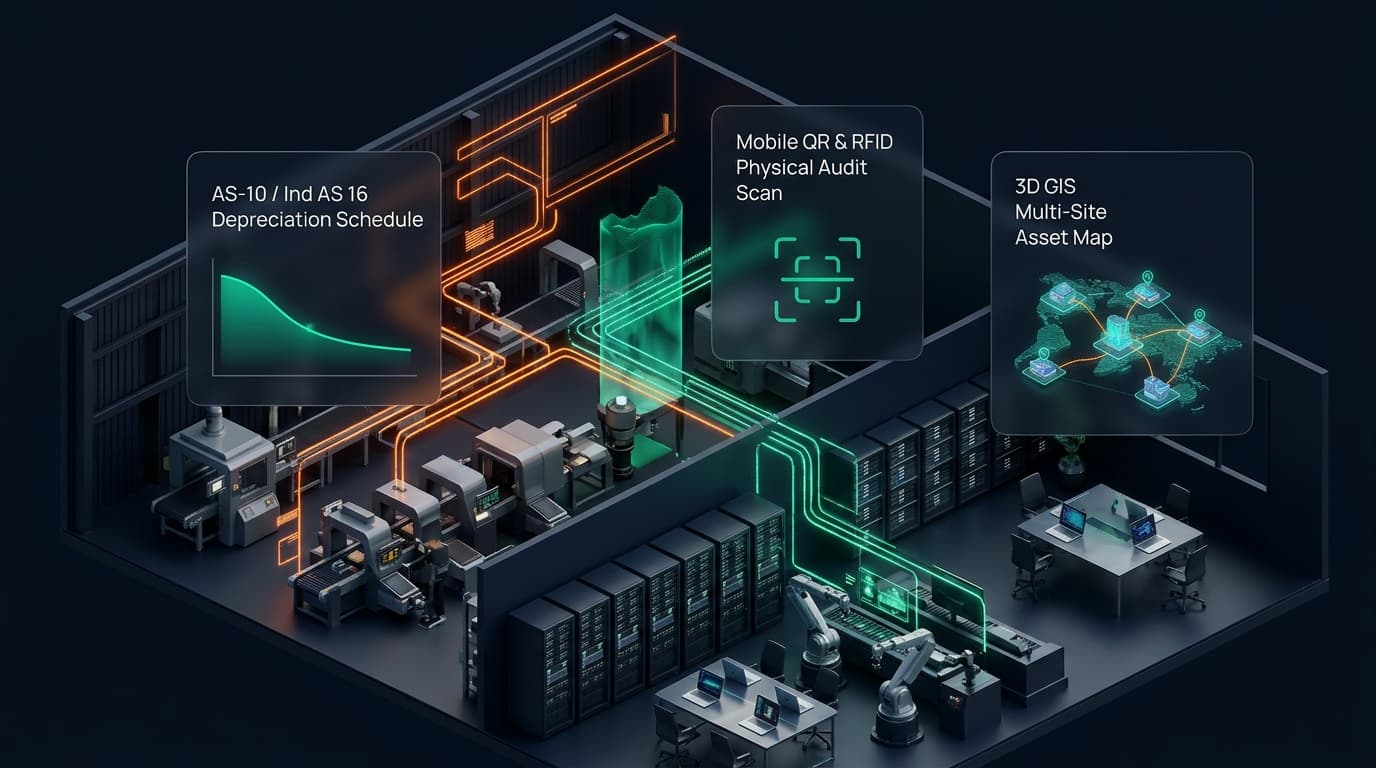
aTraket is a 6-module GIS asset lifecycle platform covering acquisition, utilisation, audit, maintenance, retirement and depreciation. It tracks IT, non-IT, movable and fixed assets across scattered branches from one cloud register. One record per asset, wherever it sits.
- Depreciation: a dual engine for Companies Act and Income Tax Act rules, with straight-line and written-down-value methods.
- Tagging: automatic barcode, QR and RFID tag generation with custom prefixes.
- Audit: mobile scanning with geo-tagged audit trails, photo proof and variance reports.
- Integration: ledger export to SAP, Tally and Oracle, plus REST APIs.
- Standards: built for AS 10 and Ind AS 16 fixed asset accounting.
- Price: quote on request. See the aTraket fixed asset and GIS modules.
Best fit? Utilities, campuses and enterprises with assets spread across many sites.
2. Asset Infinity
Asset Infinity reports more than 2,300 organisations as users. Its asset register starts at $130 a month for up to 500 assets, with unlimited users.
- Depreciation books: an extra $30 per user per month.
- Maintenance: work orders and preventive maintenance at $25 per user per month.
- Details: see the Asset Infinity pricing page.
3. EZOfficeInventory
EZOfficeInventory's Essential plan costs $81.41 a month for 500 items, with unlimited users and locations. Checkouts are its strength.
- Advanced plan: $117.11 a month adds purchase orders, audits, and scanner and RFID support.
- Premium plan: $142.10 a month for up to 30,000 units.
- Trial: 14 days free, no credit card, on the EZOfficeInventory pricing page.
4. Asset Panda
Asset Panda reports 10,000+ organisations and 50M+ assets tracked across 72+ countries since 2012. It offers purpose-built versions for local government, public works, police, fire services and schools.
- Features: barcode and QR scanning, mobile audits and an AI assistant called Ursa.
- Price: quote on request via the Asset Panda site.
5. Tracet
Tracet pairs its asset platform with on-site services such as asset verification, tagging and preparing the fixed assets register. That suits firms with no internal team to tag thousands of items, because the vendor sends people to label and verify every asset before the register goes live. Outsourcing the first audit saves months.
- Modules: fixed assets, mobile auditing, IT asset management and capital work in progress.
- Details: see the Tracet site.
6. Snipe-IT
Snipe-IT is a free, open-source IT asset tool that a company can host itself. Paid hosted plans add support for teams without servers.
- Fit: laptops, monitors and software licences rather than plant and machinery.
- Details: see the Snipe-IT pricing page.
How does asset software calculate depreciation?
The software applies 1 of 3 depreciation methods to each asset's cost, residual value and useful life. Ind AS 16 names straight-line, diminishing balance and units of production, according to the ICAI study material on Ind AS 16.
| Method | How the charge behaves | Typical use |
|---|---|---|
| Straight-line | Same amount every year | Buildings, furniture, IT |
| Diminishing balance (WDV) | Higher early, lower later | Vehicles, machinery |
| Units of production | Follows output or usage | Production equipment |
Here is an illustrative straight-line example. A ₹10,00,000 machine with a ₹50,000 residual value and a 10-year life costs ₹95,000 a year: (₹10,00,000 − ₹50,000) ÷ 10.
Why do Indian companies need two depreciation books?
Indian companies often keep 2 books because the Companies Act and the Income Tax Act set different depreciation rules. The software should compute both from one asset record. Ind AS 16 also requires useful life and the depreciation method to be reviewed at least at each financial year-end.
How much does fixed asset management software cost?
Listed plans cost about $81 to $142 a month for 500 assets on listed plans. Snipe-IT is free if you host it yourself, while enterprise tools such as aTraket and Asset Panda price by quote.
| Plan (about 500 assets) | Monthly price | Notes |
|---|---|---|
| EZOfficeInventory Essential | $81.41 | Unlimited users |
| EZOfficeInventory Advanced | $117.11 | Adds RFID and audits |
| Asset Infinity register | $130 | Depreciation books +$30 per user |
| EZOfficeInventory Premium | $142.10 | Up to 30,000 units |
| Snipe-IT self-hosted | $0 | You run the server |
Add-ons change the total. With depreciation books for 2 finance users, Asset Infinity costs $130 + (2 × $30) = $190 a month.
What is the best fixed asset management software for small business?
For a small business, EZOfficeInventory Essential at $81.41 a month is the lowest listed paid plan. Snipe-IT costs nothing for IT-only assets, provided someone can maintain the server.
- Under 500 assets, mostly equipment: EZOfficeInventory Essential.
- Needs depreciation books: Asset Infinity with the finance add-on.
- Mostly laptops and licences: Snipe-IT.
- Multi-branch with tax depreciation: aTraket.
Is there a free fixed asset management tool?
Yes: Snipe-IT is free, open-source software for IT assets. It does not replace a full fixed asset register for plant, buildings or vehicles, and it needs your own server.
Most other tools offer a trial instead. EZOfficeInventory gives 14 days free with no credit card. A free tool can work for a small IT team. Finance is different, and most teams need paid depreciation and audit features before their first year-end close.
What is the fixed asset management process?
The fixed asset management process runs from purchase to disposal in 6 stages, and fixed asset tagging starts it. Every stage writes to the same register. That is what keeps audits and depreciation accurate.
- 1Tag on arrival: attach a barcode, QR or RFID label with a unique number.
- 2Register: record cost, location, custodian and useful life.
- 3Verify: scan assets in periodic physical audits.
- 4Reconcile: flag missing, moved or damaged assets against the books.
- 5Depreciate: post monthly or annual charges to the ledger.
- 6Dispose: approve write-off and close the record.
What is RFID fixed asset management?
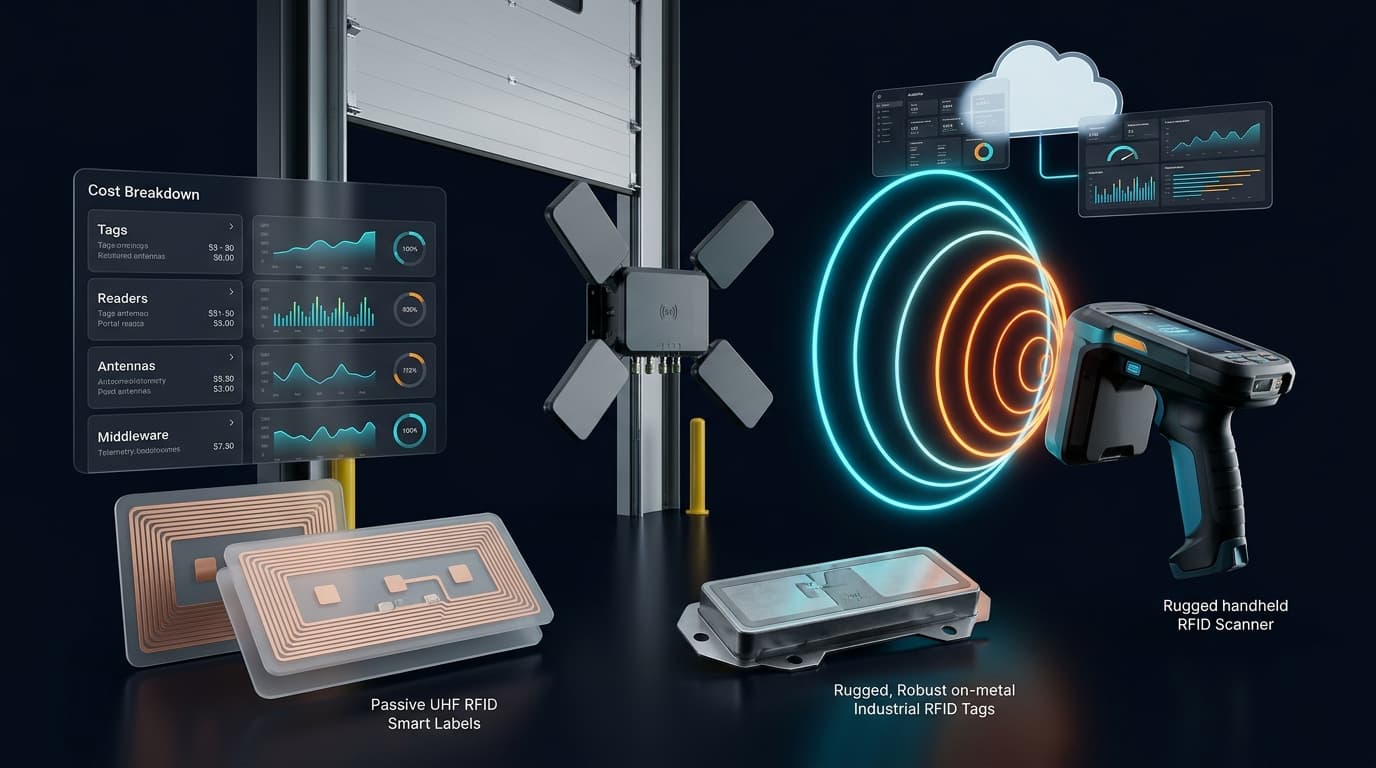
RFID fixed asset management uses radio tags that a reader detects without line of sight, often many at once. An auditor can scan a whole room in seconds, while barcodes need each label scanned one by one. RFID costs more per tag, so many firms tag high-value assets with RFID and the rest with QR codes.
Why is fixed asset management important?
Fixed asset management matters because the register drives depreciation, tax and insurance figures. Miss an asset, or count it twice, and profit, tax and audit reports all go wrong.
- Accurate books: depreciation and write-offs match the real assets.
- Lower losses: assigned custodians make missing items visible quickly.
- Better buying: idle assets get reallocated before new ones are bought.
- Clean audits: auditors get a verified register with photo evidence.
What are the best practices for fixed asset management?
The 5 fixed asset management best practices are tag everything, verify on a schedule, keep one register, review useful lives yearly and link the register to the ledger. Each one closes a gap that spreadsheets leave open. Start with tagging.
- Tag everything: one unique tag per asset, never reused.
- Verify on a schedule: run physical audits at least once a year, more often for portable items.
- Keep one register: finance, IT and operations update the same record.
- Review useful lives: check life, residual value and method each financial year-end.
- Link to the ledger: post depreciation automatically instead of re-keying it.
What mistakes should you avoid with fixed assets?
The 3 most common mistakes are ghost assets, untagged additions and manual depreciation. Ghost assets stay on the books after disposal, untagged additions never reach the register, and manual depreciation drifts from the rules.
Frequently asked questions about fixed asset management
Can software be considered a fixed asset?
Purchased software is usually an intangible asset, not property, plant and equipment. It is amortised over its useful life rather than depreciated. The exception is software that is integral to hardware, such as a machine's operating system, which is treated as part of that equipment. Your auditor confirms the treatment for each item.
What is the difference between asset management and fixed asset management?
Asset management covers every asset a company uses, including inventory and leased items, with a focus on use and maintenance. Fixed asset management focuses on long-term owned assets and their accounting: cost, depreciation, physical verification and disposal. Most modern tools, including aTraket, cover both in one register.
What KPIs track fixed asset management?
Track 4 KPIs: audit match rate, idle asset ratio, maintenance cost per asset and time to complete a physical verification. Audit match rate shows how many scanned assets agree with the books. A falling idle ratio shows assets are being reused before new purchases.
How often should fixed assets be physically verified?
Most companies verify fixed assets at least once a year, before the financial year-end close. High-value or portable assets such as laptops, tools and vehicles are often checked quarterly. Mobile scanning with barcodes, QR codes or RFID makes each audit much faster than paper checklists.
How do you move from spreadsheets to fixed asset software?
Export the spreadsheet, clean duplicates and missing serials, then import it as the opening register. Tag every asset physically before the first audit, because an untagged asset cannot be verified. Most teams run one parallel audit against the old sheet before retiring it completely.
Run your next asset audit on aTraket
aTraket keeps tagging, GIS location, physical audits and dual depreciation in one register, on cloud or on-premise. Book an aTraket walkthrough, or see how it supports smart city and utility asset management.
Bikram Pattanayak, YoByTech Automation
Published by YoByTech Automation Pvt. Ltd. Every product and pricing figure is verified directly from the respective vendor's published documentation and government/standards-body references.