Almost every RFID budget starts in the wrong place. Teams research tag prices for a week, negotiate half a cent, then get blindsided by reader count and integration. Tags are usually the smallest line in the budget. This guide breaks RFID asset tracking cost into its 5 parts and shows which ones actually decide the total.
How much does an RFID system cost?
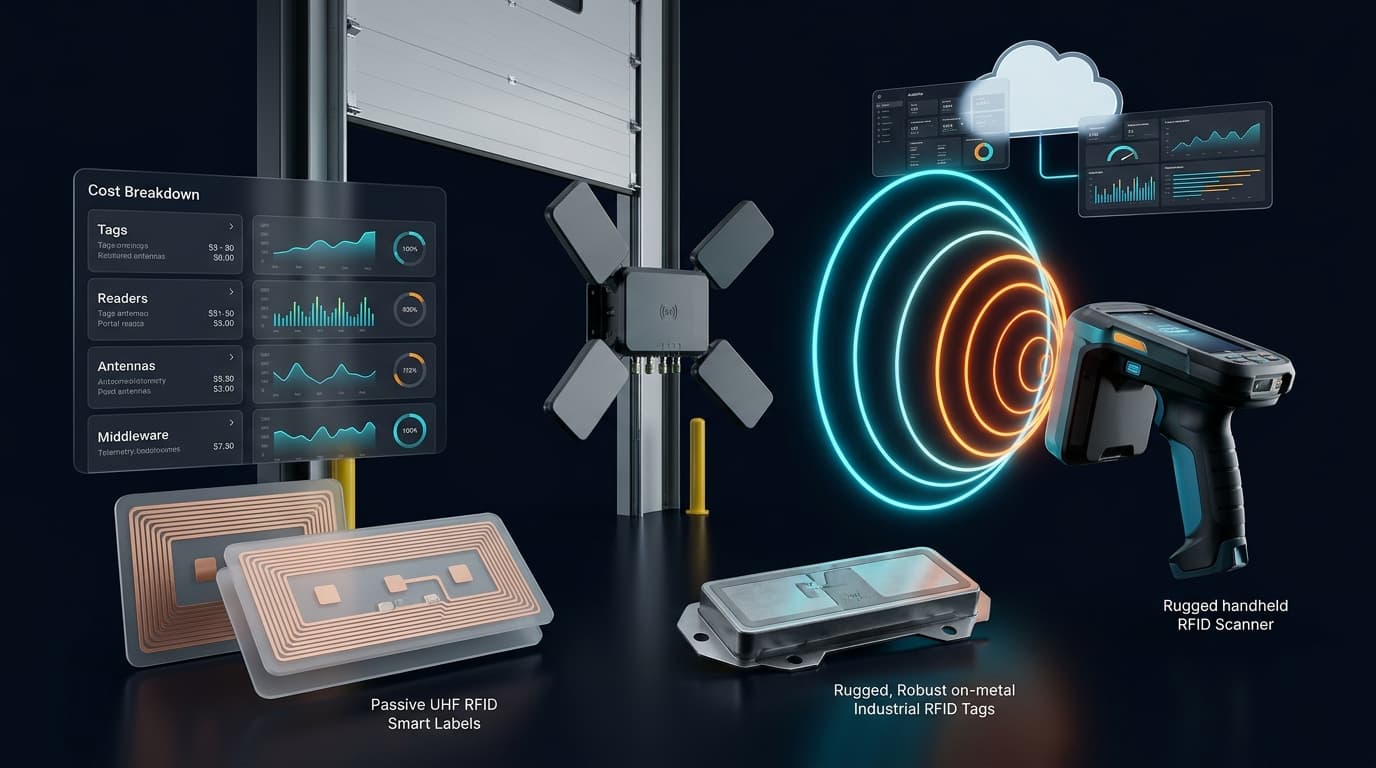
An RFID asset tracking system costs roughly $5,000 to $25,000 for a single-site pilot in year one, according to published ranges from asset tracking vendor RedBeam. Multi-site enterprise deployments run $100,000 to $250,000 or more.
| Component | Published range |
|---|---|
| Passive labels and inlays | $0.04 to $0.25 per tag |
| On-metal passive tags | $0.75 to $5.00 per tag |
| Rugged and specialty passive tags | $3.00 to $15.00 per tag |
| Active tags | $15.00 to $50.00+ per tag |
| Fixed readers | $1,000 to $4,000 each |
| Handheld readers | $1,500 to $3,000 each |
| Antennas | $150 to $300 each |
| RFID printers and encoders | $1,500 to $6,000 |
| Software | $100 to $3,500+ per month |
| Integration and deployment | $2,000 to $25,000+ |
A second vendor, Korona POS, puts passive UHF tags at $0.05 to $0.30 each and active tags at $15 to $50 or more, which lines up closely on tags. Treat both as planning ranges and get a quote before committing a budget.
Because tags are a small share of the first-year bill. RedBeam's guidance is blunt about it: on a typical mid-size enterprise deployment, readers, software and integration are usually 60% to 80% of first-year cost.
The practical consequence is a planning rule. A team that negotiates hard on tag price but guesses the reader count will miss its budget. A team that gets reader count and software tier right lands close, even after overpaying slightly per tag.
How many readers do you actually need?
Reader count follows how you intend to read, not how many assets you own. 3 patterns cover most asset tracking projects:
- Handheld audit: 1 or 2 handhelds for the whole site, used during physical verification.
- Choke points: fixed readers at doors, gates and loading bays to catch movement.
- Zone coverage: many fixed readers and antennas to know where assets are continuously.
The jump from handheld audits to continuous zone coverage is what turns a $10,000 project into a $100,000 one. Most fixed-asset registers do not need it.
What drives RFID tag prices?
Tag price is driven by what the tag must survive, not by the chip inside it. A paper label and an on-metal tag use similar silicon. They differ in price by a factor of 20 or more.
| Factor | Effect on price |
|---|---|
| Form factor | Paper label cheapest; rugged housings far dearer |
| Mounting surface | On-metal and on-liquid tags cost more |
| Read range | Longer range needs better antenna design |
| Environment | Heat, chemicals and washdown raise cost |
| Volume | Per-tag price falls sharply at high volume |
| Active vs passive | Active tags carry a battery and cost $15+ |
Most fixed-asset programmes use passive tags. Active tags make sense when assets must report their own position continuously, such as vehicles or high-value mobile equipment, and the battery life becomes a maintenance item of its own.
RFID vs barcode vs QR vs BLE: which costs less?
RFID is not always the cheapest answer. Plenty of asset registers run perfectly well on barcode or QR labels, and the honest comparison is cost against scanning effort.
| Technology | Tag cost | Reader cost | Line of sight | Best for |
|---|---|---|---|---|
| Barcode or QR | Near zero, printed | Phone or scanner | Required | Low-volume audits, tight budgets |
| Passive RFID | $0.04 to $15 | $1,000 to $4,000 | Not required | Fast bulk audits, choke points |
| Active RFID | $15 to $50+ | Infrastructure | Not required | Continuous location of high-value assets |
| Bluetooth low energy | Battery tags | Gateways or phones | Not required | Zone-level location, phone-based reads |
QR code asset tracking wins on cost whenever an annual audit is the main requirement and someone can walk the site. RFID wins when scanning hundreds of items one at a time is the bottleneck, because a reader can count a room in seconds.
The 5 costs below rarely appear on a vendor's first quote and regularly decide whether a project lands on budget.
- 1Tagging labour: physically applying and registering thousands of tags.
- 2Data cleanup: the asset register usually has duplicates, ghosts and missing serials.
- 3Site survey and tuning: metal, liquids and racking all affect read reliability.
- 4Network and power: fixed readers need both, often where neither exists.
- 5Training and process change: audits only get faster if the process changes too.
On regulated or audited sites, add a sixth. NIST's Guidelines for Securing Radio Frequency Identification Systems sets out the controls an RFID deployment is expected to carry across tag data, reader access and the back-end register. Budget the review time before procurement, not after the readers arrive.
Tagging labour is the one most often underestimated. Tagging 5,000 assets is a project in itself. That is why several vendors sell verification and tagging as a service rather than leaving it to the customer.
How do you calculate RFID ROI for asset tracking?
Calculate RFID ROI from audit time saved and assets recovered, in 4 steps. Both are measurable before you buy anything.
- 1Time the current audit: people, days and how often it runs.
- 2Price that time: fully loaded hourly cost, including overtime.
- 3Count your ghost assets: items on the books that no longer exist.
- 4Compare with the quote: including tagging labour and year-two software.
Here is an illustrative calculation. If 4 staff spend 10 days a year on a physical audit at ₹500 an hour, that audit costs about ₹1,60,000 a year. Cutting it to 2 days saves ₹1,28,000 annually, before counting avoided write-offs on assets nobody could find.
Ghost assets often dominate the return. An asset still carried on the register attracts depreciation, insurance and sometimes maintenance contracts long after it has physically gone.
What software do you need with RFID?
RFID hardware produces reads; software turns them into an asset register with history, depreciation and audit trails. Published software costs run $100 to $3,500+ per month depending on tier.
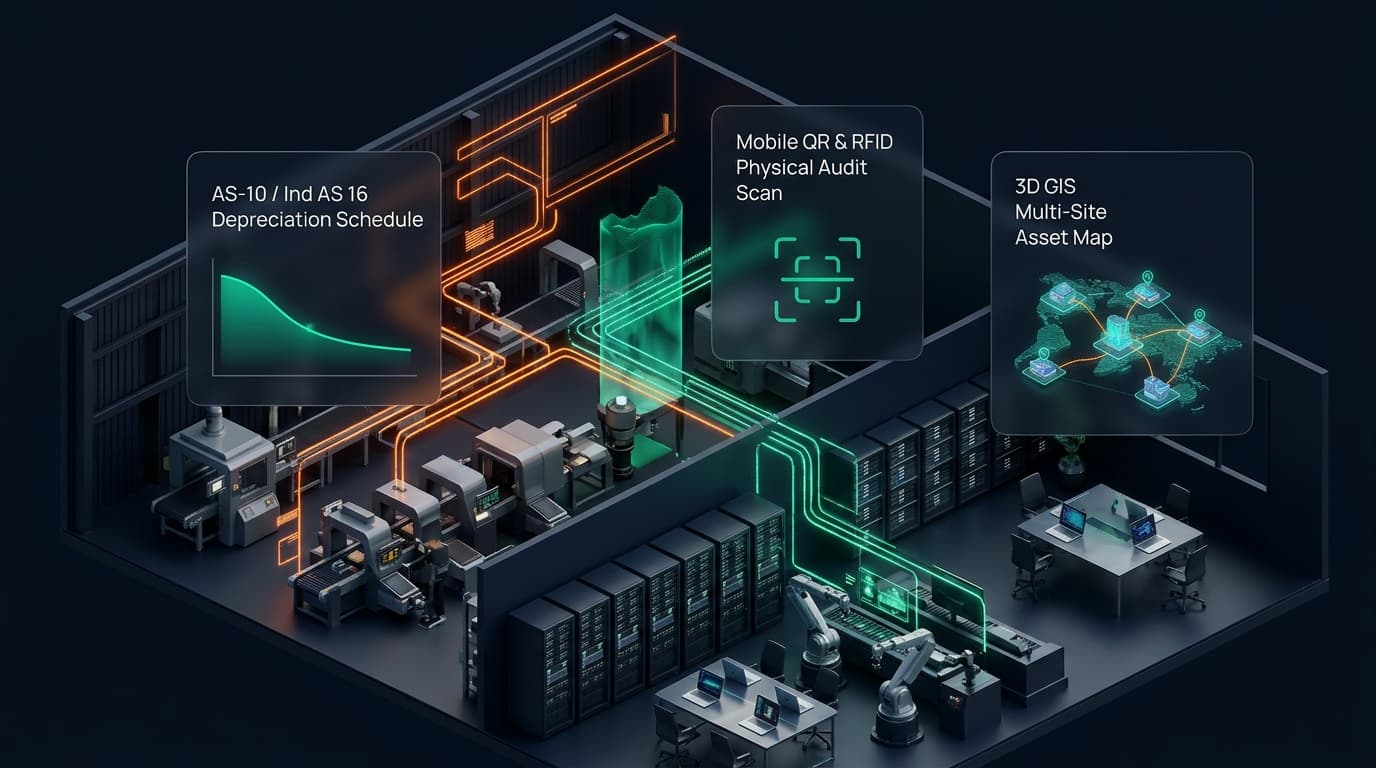
aTraket, YoByTech's asset platform, generates barcode, QR and RFID tags with custom prefixes at procurement, then uses mobile scanning for physical audits with geo-tagged trails and photo proof. It also runs dual Companies Act and Income Tax depreciation, so the register the auditor sees matches the tags on the floor. See the aTraket asset lifecycle modules.
How do you keep an RFID project on budget?
Keep the project on budget in 5 steps, and resist full zone coverage until a simpler approach has been tried.
- 1Start with a handheld audit pilot: 1 department, 1 handheld, real assets.
- 2Measure the audit time saved: against the baseline you timed earlier.
- 3Add choke-point readers only where movement matters: doors and gates first.
- 4Tag by value, not uniformly: RFID on high-value assets, QR on the rest.
- 5Budget year 2: software renewal, replacement tags and new asset tagging.
A mixed-technology register is normal, and usually cheaper. See how tagging fits the wider process in our guide to fixed asset management software.
Frequently asked questions about RFID costs
How much does an RFID tag cost?
Published vendor ranges put passive RFID labels and inlays at $0.04 to $0.25 each, with a second vendor quoting $0.05 to $0.30. On-metal passive tags run $0.75 to $5.00, rugged and specialty tags $3.00 to $15.00, and active battery-powered tags $15.00 to $50.00 or more. Volume reduces per-tag price substantially.
Is RFID worth it for asset tracking?
RFID is worth it when scanning volume is the bottleneck, because a reader counts hundreds of tagged items in seconds without line of sight. For a few hundred assets audited once a year, QR or barcode labels usually deliver the same register at a fraction of the hardware cost.
How long does an RFID asset tracking project take?
A single-department pilot with handheld readers can run in a few weeks, most of it spent tagging assets and cleaning the register rather than configuring software. Full site deployments with fixed readers take months, because they need a site survey, network and power work, and a tagging programme across every location.
Do RFID tags need batteries?
Passive tags have no battery. They draw power from the reader's signal, which is why they cost cents and last for years. Active tags carry a battery, transmit on their own and cost $15 or more, with battery replacement becoming a maintenance task. Most fixed-asset registers use passive tags.
Can you mix RFID and QR codes in one asset register?
Yes, and it is usually the cheapest approach. Tag high-value or frequently moved assets with RFID, and label everything else with QR or barcode. One register holds both, so audits use a handheld reader in some areas and a phone camera in others.
Tag, audit and depreciate in one system
aTraket covers RFID, QR and barcode tagging, mobile physical audits and dual-method depreciation in a single register, on cloud or on-premise. Get an aTraket costing for your asset count, or see how it supports smart city and utility asset management.
Bikram Pattanayak, YoByTech Automation
Published by YoByTech Automation Pvt. Ltd. Every product and pricing figure is verified directly from the respective vendor's published documentation and government/standards-body references.