Intelligent video analytics (IVA) is software that applies computer vision and deep learning to live camera streams to detect people, vehicles, objects and events automatically. Instead of a guard watching dozens of screens, the AI watches every feed 24/7 and only raises the events that matter. This guide covers 12 IVA use cases across factories, utilities and roads, with what each detects and where it pays off.
What is intelligent video analytics?
IVA is AI that reads video the way a trained officer would, but on every camera at once. It classifies what it sees, applies rules such as "no helmet" or "person in red zone", and triggers an alert, a siren or a gate interlock within about 1 second.
Older video motion detection only noticed that pixels changed. Video analytics artificial intelligence goes further: deep-learning models tell a worker from a forklift, a flame from a reflection and a leak from a shadow. That shift matters. False alarms fell far enough that plants and cities now let alerts trigger sirens, barriers and pump trips without waiting for a person to confirm.
How does intelligent video analytics work?
IVA works in 4 stages, from camera stream to safety report. YoByTech's intelligent video analytics software, for example, runs each stage on an edge box inside the plant.
- 1Connect existing cameras: the edge box reads RTSP streams from IP cameras that support the ONVIF profiles, so no cameras are replaced.
- 2Detect at the edge: deep-learning models run on GPU hardware, often optimised with NVIDIA TensorRT, in under 200 ms per frame.
- 3Act in under 1 second: the system saves a timestamped snapshot and clip, then sounds a hooter, drops a boom barrier or trips a pump through a PLC.
- 4Report: zone-wise risk heatmaps and incident logs feed safety scorecards and audits.
Each camera can carry several models at once. One gate camera can check helmets, read number plates and measure speed in the same stream. Nothing extra to install.
What are the 12 use cases of intelligent video analytics in 2027?
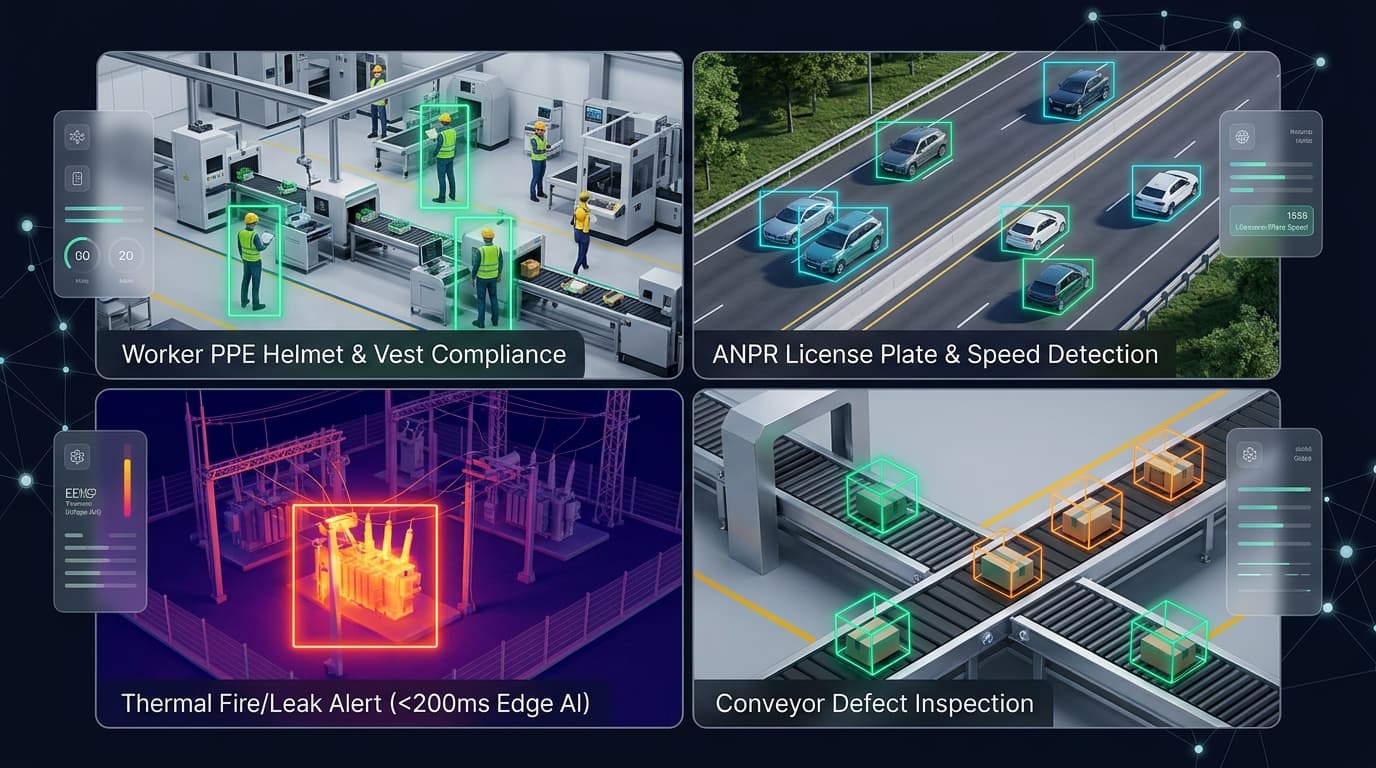
The 12 IVA use cases fall into 5 groups: road safety, worker safety, hazards, perimeter and quality, and access. The table maps each one to what the camera detects and where it is used.
| Use case | What the camera detects | Typical site |
|---|---|---|
| 1. Helmet and triple-riding checks | Two-wheeler riders without helmets or 3 on a bike | Plant roads, campus gates |
| 2. Overspeeding with ANPR | Vehicle speed plus number plate | Haul roads, highways |
| 3. ANPR gate pass | Plates matched to allow or block lists | Factory and port gates |
| 4. PPE compliance | Helmet, vest, gloves, goggles, harness | Shop floors, construction bays |
| 5. Man-down alerts | A worker who falls and stays down | Plants, warehouses |
| 6. Red-zone proximity | People near cranes or moving machines | Steel, cement, ports |
| 7. Fire and smoke | Early flame and smoke plumes | High-ceiling bays, stores |
| 8. Water and oil leaks | Pipe bursts and floor spills | Pump houses, substations |
| 9. Perimeter intrusion | Fence climbing, tripwire crossing, animals | Boundary walls, utilities |
| 10. Defect inspection | Surface, label and packaging faults | Production lines |
| 11. Face-based access | Known faces for attendance and zone entry | Plants, campuses |
| 12. Crowd analytics | Group crowding and zone counts | Gates, canteens, events |
How does video analytics improve road safety in plants?
Video analytics improves road safety by catching the 3 violations that cause most internal crashes: no helmet, triple riding and overspeeding. The stakes are national. India recorded 4,61,312 road accidents and 1,68,491 deaths in 2022, a 9.4% rise in deaths, according to the Ministry of Road Transport and Highways.
- Use case 1, helmet and triple riding: two-wheelers caused 44.5% of road deaths in 2022, and the WHO finds a proper helmet cuts death risk 6 times, as reported in a Press Information Bureau helmet note. YoByTech runs automated helmet and triple-riding enforcement with ANPR evidence at Paradeep Phosphates.
- Use case 2, overspeeding with ANPR: cameras fuse speed readings with plate capture. YoByTech deployed this along internal haul roads at GMR Kamalanga Energy.
- Use case 3, ANPR gate pass: plates are matched against approved and blacklisted vehicles, so gates open without manual registers. The same ANPR tools support smart city traffic and infrastructure monitoring.
How does video analytics protect workers?
Video analytics protects workers by checking PPE and movement on every shift, not only during audits. A single safety officer cannot watch every bay, but 1 edge box can watch dozens of streams in parallel.
- Use case 4, PPE compliance: models verify helmets, reflective vests, gloves, goggles and harnesses, then log each miss with a photo.
- Use case 5, man-down alerts: pose estimation spots a worker who collapses and raises an emergency alert within seconds.
- Use case 6, red-zone proximity: virtual zones around cranes and moving machinery warn when a person steps inside.
How does video analytics detect fire and leaks early?
Video analytics detects fire and leaks by recognising flame, smoke and spreading liquid on camera, often before ceiling sensors react. In high-ceiling bays, smoke can take minutes to reach a detector, while a camera sees it at floor level.
- Use case 7, fire and smoke: optical models flag early sparks and smoke plumes, then sound sirens.
- Use case 8, water and oil leaks: cameras spot pipe bursts and hydraulic or transformer oil spills, and a PLC interlock can trip the pump.
How is video analytics used for security and quality?
Video analytics for security draws virtual fences on camera, while the same AI on line cameras inspects products. Both replace slow manual watching with 24/7 checks. Nobody gets tired.
- Use case 9, perimeter intrusion: intrusion detection video analytics uses tripwires to flag fence climbing, stray animals and weapons at gates.
- Use case 10, defect inspection: high-speed line cameras check packaging, labels and surfaces and reject faulty units.
- Use case 11, face-based access: touchless face recognition records attendance and blocks entry to restricted zones.
- Use case 12, crowd analytics: zone counts warn when groups gather at gates, canteens or event exits.
Is intelligent video analytics the same as intelligent video surveillance?
No: intelligent video surveillance is the wider security system, and IVA is the AI layer inside it. Surveillance records and stores footage, while analytics interprets it in real time and acts.
| Aspect | Video surveillance (CCTV) | AI video analytics |
|---|---|---|
| Main job | Record and store footage | Detect events and act |
| Who watches | People at screens | AI models, 24/7 |
| Output | Recorded video | Alerts, snapshots, reports |
| Response | Minutes or after the event | Under 1 second |
Upgrading CCTV with video analytics does not mean choosing one over the other. Cameras feed the recorder as before, and the analytics layer reads the same streams.
Should video analytics run at the edge or in the cloud?
Edge processing suits most plants, because alerts stay under 1 second and video never leaves the site. Cloud processing suits multi-site dashboards and long-term trend analysis, where a few seconds of delay is acceptable.
| Factor | Edge AI box on site | Cloud analytics |
|---|---|---|
| Alert speed | Under 1 second | Seconds, depends on upload |
| Internet needed | No, works offline | Yes, constant upload |
| Data privacy | Video stays on premises | Video leaves the site |
| Best for | Safety interlocks, gates | Cross-site reporting |
Many deployments combine both. The edge box detects and acts, then sends only events and snapshots to a cloud dashboard, which keeps bandwidth low while still giving head office a single view of every site.
How accurate is AI video analytics?
AI video analytics accuracy depends on camera angle, lighting and training data more than on the model brand. YoByTech reports 99.4% real-time detection accuracy with under 1 second alert latency for its calibrated deployments.
Real plants are messy. Dust, glare, rain, night shifts and partly hidden workers all cause misses or false alarms. Models trained on real Indian plant footage, and recalibrated after go-live, close most of that gap.
What are the challenges of AI video analytics?
The 4 biggest challenges are poor camera placement, false alarms, network load and privacy. Each one is fixable in the design stage. Fix them before buying hardware.
- Camera placement: a camera mounted too high or against the light cannot see a helmet strap or a number plate.
- False alarms: untuned zones flood operators with alerts until they ignore them.
- Network load: streaming every camera to the cloud can saturate a plant link, so edge processing helps.
- Privacy: face data needs clear consent, retention rules and access control.
What mistakes should you avoid when deploying video analytics?
The most common mistake is buying cameras and software before defining which 3 to 5 events matter most. Start with measurable goals, such as cutting helmet violations at one gate, and expand only after the first zone runs cleanly for a full month of shifts.
- Avoid: enabling every model on every camera on day 1.
- Avoid: skipping calibration with real footage from each camera before go-live.
- Avoid: sending alerts to a shared inbox nobody owns.
How do you implement video analytics in a plant?
Roll out IVA in 5 steps, starting with a short camera audit. Most plants can start with the IP cameras they already run. Budgets stretch further.
- 1Define the events: list the violations and hazards to catch, such as helmets, leaks or intrusions.
- 2Audit cameras: check angle, resolution, lighting and ONVIF support for each zone.
- 3Pilot one zone: run the models on 1 gate or bay and tune zones and thresholds.
- 4Connect actions: link alerts to hooters, boom barriers, PLCs and the right supervisors.
- 5Scale and review: add zones and review monthly safety scorecards.
See how YoByTech applies these steps in AI computer vision for industrial safety and in its manufacturing safety deployments.
Frequently asked questions about IVA
Do you need new cameras for intelligent video analytics?
Usually not. Most IVA systems read RTSP streams from existing IP cameras, including Hikvision, Axis, Dahua and Bosch models that support ONVIF. You only replace cameras whose angle, resolution or night performance cannot capture the detail a model needs, such as a number plate or helmet.
What hardware does IVA need?
Edge deployments need a GPU-based AI box on the plant network, sized to the number of camera streams. Many use NVIDIA GPUs with TensorRT for fast inference. You also need a network switch, a recorder for footage, and outputs such as hooters, boom barriers or PLC links for automatic actions.
Can video analytics work without the internet?
Yes, edge video analytics works fully offline. The AI box processes streams on site, triggers alarms and stores events locally. An internet link is only needed to send alerts to phones or a cloud dashboard, and many plants choose 100% on-premise processing for data privacy.
Which industries use intelligent video analytics most?
Manufacturing, energy, ports, logistics, smart cities and campuses use AI video analytics most. Plants focus on PPE, fire and leak detection. Cities use it for traffic and ANPR. Campuses use face-based attendance and access control, while utilities use perimeter intrusion detection around remote sites.
What is video analytics a good example of?
Video analytics is a good example of applied computer vision, a branch of artificial intelligence. It shows how deep-learning models can turn unstructured video into structured events, such as "vehicle at 52 km/h, plate captured", that people and machines can act on automatically.
Does intelligent video analytics raise privacy concerns?
Yes, particularly where face recognition is used. Plants need a clear lawful basis, defined retention periods and role-based access to footage. Many deployments avoid the issue entirely by detecting PPE, hazards and vehicles rather than identifying individuals, which answers most safety requirements.
See AI video analytics on your own cameras
YoByTech's edge AI vision boxes run 40+ pre-built safety, road, hazard and PPE models on existing CCTV. Request an engineering consultation to pilot one zone in your plant.
Bikram Pattanayak, YoByTech Automation
Published by YoByTech Automation Pvt. Ltd. Every product and pricing figure is verified directly from the respective vendor's published documentation and government/standards-body references.