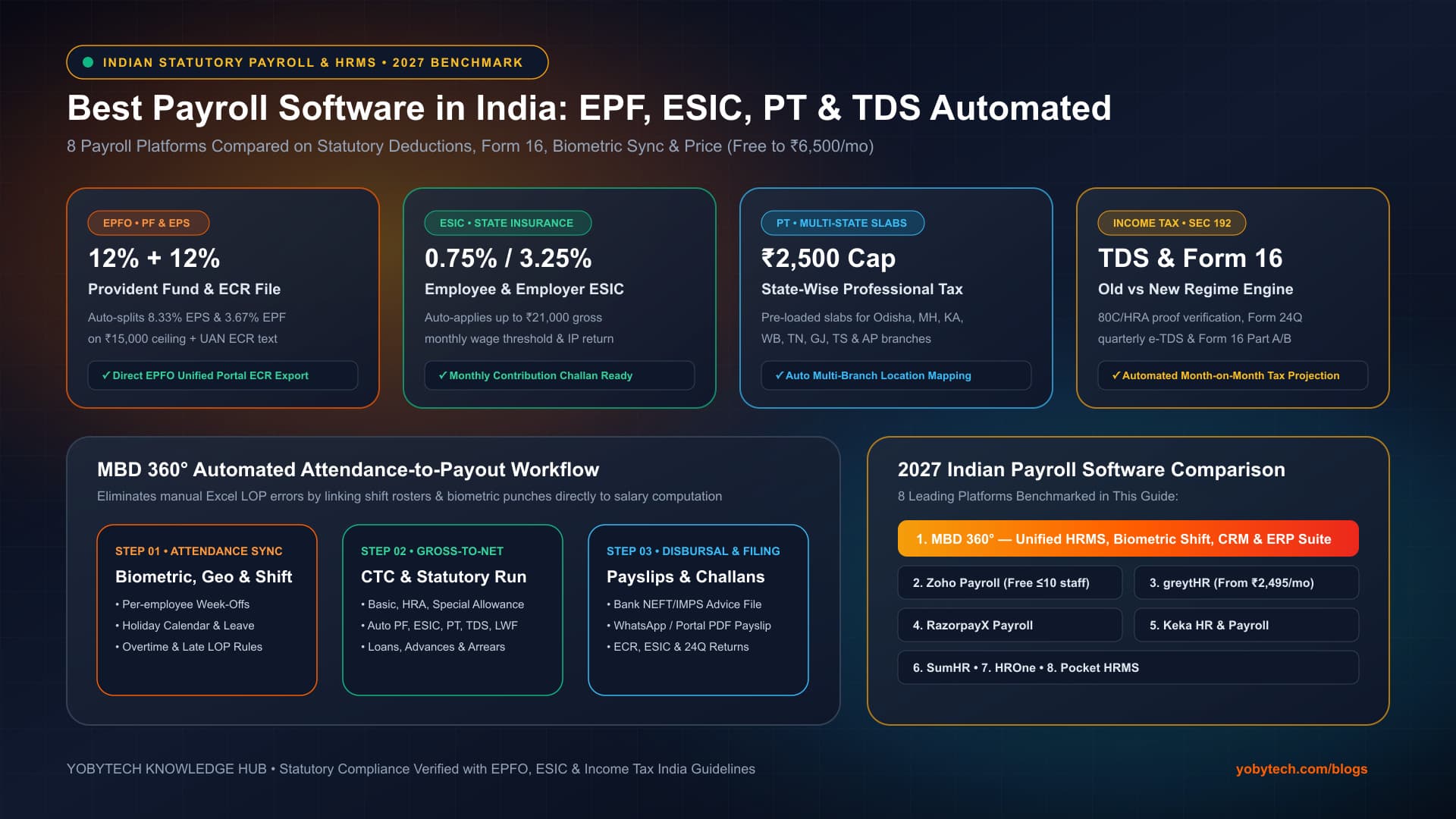
Payroll in India is not salary times days worked. Every month a payroll run must apply Provident Fund, Employees' State Insurance, state Professional Tax and TDS, then produce challans, payslips and Form 16 that survive an audit. This guide compares 8 payroll tools on statutory coverage, attendance links and price.
Which is the best payroll software in India in 2027?
There is no single winner, because a 15-person startup and a 500-person factory have different compliance loads. The table ranks each tool by the business it fits.
| Payroll tool | Best for | Listed starting price | Free option |
|---|---|---|---|
| 1. MBD360 (YoByTech) | Payroll inside a wider CRM and operations suite | Quote on request | Demo |
| 2. Zoho Payroll | Small teams wanting zero-cost compliance | ₹0 up to 10 employees | Free forever |
| 3. greytHR | SMEs needing payroll plus HR | ₹2,495/month for 50 staff | 7-day trial |
| 4. RazorpayX Payroll | Startups paying salaries from one account | ₹3,499/month for 20 staff | Not listed |
| 5. factoHR | Micro teams and growing SMEs | ₹0 up to 20 employees | Free plan |
| 6. Keka | Mid-sized firms wanting modern HR | ₹90 per additional employee | Free trial |
| 7. HROne | Field and plant teams | ₹4,950/month for 50 users | Free trial |
| 8. sumHR | Per-employee annual billing | ₹1,428 per employee a year | Demo |
What is payroll software and what should it do in India?
Payroll software calculates each employee's gross pay, applies statutory and voluntary deductions, and generates payslips, bank files and compliance returns. In India, the statutory layer is what separates real payroll software from a salary spreadsheet.
Indian payroll software must handle 4 deductions:
- 1Provident Fund (PF): employee and employer contributions, with UAN records.
- 2ESIC: employee and employer shares for covered employees.
- 3Professional Tax: state-specific slabs, which differ across states.
- 4TDS: monthly tax deduction with year-end Form 16.
What are the ESI contribution rates?
ESI is split between employer and employee. The employer pays 3.25% of wages and the employee pays 0.75%, reduced from a combined 6.5% to 4% with effect from 1 July 2019, according to the Press Information Bureau. The same release notes the coverage wage ceiling rose from ₹15,000 to ₹21,000 a month in January 2017.
Those rates are exactly the kind of rule that should never live in a spreadsheet formula. When one changes, software updates once and every future run is correct. A spreadsheet needs someone to remember.
What are the top payroll software tools in India?
The 8 tools below cover free plans, SME suites and enterprise HR. For each tool: who it suits, what stands out and what the vendor publishes as its price.
1. MBD360 by YoByTech
MBD360 runs payroll as 1 of 8 modules, beside CRM, projects, complaints, AMC and tasks. It suits a company that wants one system for the whole business rather than payroll bought separately.
- Statutory: automated salary computation with PF, ESIC, Professional Tax and TDS deductions.
- Attendance input: payroll reads biometric, face-recognition and geo-tagged mobile check-in data directly, so days paid match days worked.
- Self-service: one-click leave, encrypted payslips, Form 16 access and expense claims with receipt photos.
- Reported result: YoByTech reports 100% payroll accuracy on the platform.
- Price: quote on request. See the MBD360 HR and payroll modules.
Best fit? Firms whose sales, delivery and HR data currently sit in three unconnected tools.
2. Zoho Payroll
Zoho Payroll is free forever for up to 10 employees, which makes it the cheapest compliant start in India. Paid plans add depth as headcount grows.
- Standard: ₹1,000 per organisation per month billed annually, including 25 employees, then ₹40 per extra employee.
- Professional: ₹3,000 billed annually, including 50 employees, then ₹60 each.
- Premium: ₹4,000 billed annually with leave and attendance management, then ₹80 each.
- Details: see the Zoho Payroll India pricing page.
3. greytHR
greytHR reports more than 34,000 companies and 3.5 million employees. Its Essential plan is ₹2,495 a month with 50 employees included, plus ₹45 per extra employee.
- Growth plan: ₹4,495 a month for 50 employees, then ₹85 each.
- Security: lists ISO 27001 and SOC II Type 2.
- Details: see the greytHR pricing page.
4. RazorpayX Payroll
RazorpayX Payroll links payroll to payouts, so salaries leave the same account that runs the business. Prime costs ₹3,499 a month for up to 20 employees.
- Elite plan: listed at ₹6,499 a month for 50 employees, then ₹150 per extra employee.
- GST: an additional 18% applies to these prices.
- Where to check: tiers and GST are set out on the RazorpayX Payroll pricing page.
5. factoHR
factoHR offers a free plan for up to 20 employees covering employee data, letters and payslip generation. Full payroll sits on the paid tier.
- Core plan: ₹4,999 a month for up to 50 employees, then ₹99 each, billed quarterly.
- Scale: factoHR reports 4,000+ businesses across India.
- Details: see the factoHR pricing page.
6. Keka
Keka prices per additional employee rather than by a flat base, starting at ₹90 on the Foundation plan. It reports more than 12,500 companies using the platform.
- Higher tiers: ₹120 on Strength and ₹150 on Growth, which adds performance management and workflow automation.
- Details: see the Keka pricing page.
7. HROne
HROne's Basic plan is ₹4,950 a month for 50 users, then ₹99 per extra user, and includes geo-tagging, geo-fencing, selfie attendance and offline attendance. Field and shift attendance drive payroll here.
- Professional plan: ₹6,500 a month for 50 users, then ₹130 each.
- Where to check: plan detail sits on the HROne pricing page.
8. sumHR
sumHR charges ₹1,428 a year per employee, about ₹119 a month, with no base fee. That model suits firms with steady headcount and tight budgets, since there is no base fee to absorb before the first payslip is produced. Predictable, if inflexible.
- Details: see the sumHR website.
How much does payroll software cost in India?
Payroll software in India costs between ₹0 and about ₹6,500 a month for a 50-person company on listed plans. The pricing model matters more than the headline figure, because per-employee charges compound.
| Plan (50 employees) | Monthly price | Each extra employee |
|---|---|---|
| Zoho Payroll Professional | ₹3,000 (annual billing) | ₹60 |
| Zoho Payroll Premium | ₹4,000 (annual billing) | ₹80 |
| greytHR Essential | ₹2,495 | ₹45 |
| greytHR Growth | ₹4,495 | ₹85 |
| HROne Basic | ₹4,950 | ₹99 |
| factoHR Core | ₹4,999 | ₹99 |
| RazorpayX Payroll Elite | ₹6,499 + 18% GST | ₹150 |
Our calculation shows what happens at scale. At 200 employees, greytHR Essential costs ₹2,495 + (150 × ₹45) = ₹9,245 a month, while RazorpayX Elite costs ₹6,499 + (150 × ₹150) = ₹28,999 before GST.
Which pricing model is cheaper at your headcount?
Per-organisation pricing wins below about 50 employees, and per-employee pricing only catches up when a vendor's base fee is high. The crossover is worth calculating before you commit to an annual plan.
| Headcount | Zoho Payroll Professional | greytHR Essential | RazorpayX Elite |
|---|---|---|---|
| 50 | ₹3,000 | ₹2,495 | ₹6,499 |
| 100 | ₹6,000 | ₹4,745 | ₹13,999 |
| 200 | ₹12,000 | ₹9,245 | ₹28,999 |
Figures are our calculation from each vendor's published base price and per-employee rate, before GST. The spread at 200 employees is more than ₹19,000 a month, which is larger than most firms' entire HR software budget.
Is GST included in payroll software prices?
Most Indian vendors list prices before GST. RazorpayX Payroll states 18% GST separately, so a ₹3,499 plan actually costs ₹4,129 a month. Budget for GST on every quote you compare.
Is there free payroll software in India?
Yes: Zoho Payroll is free forever for up to 10 employees, and factoHR has a free plan for up to 20 employees covering records and payslips. Both have clear limits.
- Zoho Payroll Free: full payroll for a very small team, up to 10 employees.
- factoHR Free: employee data, letters and payslips, but payroll features sit on Core.
- Trials: greytHR, Keka, HROne and Zoho all list free trials rather than free tiers.
A free plan is genuinely enough for a 10-person company. The moment you cross that line, the cheapest compliant option is usually a per-organisation plan rather than a per-employee one. Watch the jump carefully: moving from a free tier to a paid plan often costs more than the next two upgrades combined, because the base fee arrives all at once rather than scaling with the eleventh hire.
What is the best payroll software for a small business in India?
For a small business in India, Zoho Payroll Free costs nothing up to 10 employees and still files statutory deductions. Between 10 and 50 employees, greytHR Essential at ₹2,495 a month is the lowest listed paid plan with full HR.
- Under 10 employees: Zoho Payroll Free.
- 10 to 50 employees: greytHR Essential or Zoho Payroll Standard.
- Field or shift teams: HROne, for geo-attendance.
- Payroll plus CRM and projects: MBD360.
What does a payroll run involve step by step?
An Indian payroll run has 7 steps, and software should automate 5 of them. The 2 that stay human are approving inputs and releasing the payment.
- 1Freeze inputs: attendance, leave, overtime, new joiners and exits for the period.
- 2Apply the salary structure: basic, HRA, allowances and any arrears.
- 3Calculate deductions: PF, ESIC, Professional Tax, TDS, loans and advances.
- 4Review the register: compare against last month and investigate every large variance.
- 5Approve: finance signs off the net pay total.
- 6Pay: generate the bank advice file and release salaries.
- 7File and publish: produce challans and returns, then release payslips to self-service.
Step 4 is the one teams skip under deadline pressure. A month-on-month variance report catches a mistyped salary revision before it reaches an employee's account, which is far cheaper than a recovery conversation afterwards.
What reports should payroll software produce?
Payroll software should produce 7 outputs without anyone rebuilding them in Excel. If any of these needs manual work every month, the tool is not finished.
| Output | Who needs it | When |
|---|---|---|
| Payslips | Employees | Every pay cycle |
| Salary register | Finance | Every pay cycle |
| Bank advice file | Finance and bank | Before payment |
| PF contribution file | EPFO filing | Monthly |
| ESI contribution file | ESIC filing | Monthly |
| TDS working and returns | Tax filing | Monthly and quarterly |
| Form 16 | Employees | Annually |
Ask for samples of all 7 during the trial, generated from your own data. A clean demo payslip proves very little, because the hard part is an employee with mid-month joining, arrears and a loan deduction in the same month.
Should you use payroll software or outsource payroll?
Software and outsourcing solve different problems. Software gives you control and lower running cost; outsourcing gives you someone else's expertise and accountability for filings.
| Factor | Payroll software | Outsourced payroll |
|---|---|---|
| Monthly cost | Lower, fixed by plan | Higher, usually per employee |
| Who owns compliance | Your team | The provider, by contract |
| Speed of change | Immediate, you edit it | Depends on the provider |
| Data control | Stays in your system | Shared with a third party |
| Best for | In-house HR or finance capacity | No internal payroll expertise |
A common middle path is software plus a chartered accountant who reviews the output and handles filings. That keeps the monthly cost near the software price while putting a professional between your data and the tax department.
How do you choose payroll software in India?
Choose payroll software in India by testing it on your own salary month, in 5 steps. A demo on sample data hides the problems that matter.
- 1List your states: Professional Tax slabs differ, so count every state you pay in.
- 2Check the Labour Codes: the 4 codes took effect on 21 November 2025, replacing 29 laws, per the Press Information Bureau.
- 3Run a parallel month: process last month in the new tool and compare every deduction.
- 4Test the outputs: PF and ESI files, TDS reports, payslips and Form 16.
- 5Price at next year's headcount: multiply the per-employee rate by your hiring plan.
What mistakes should you avoid when switching payroll?
The 3 common mistakes are migrating dirty master data, skipping the parallel run and switching mid-financial-year. Clean UAN, PAN and ESIC numbers first, and prefer an April switch so year-to-date figures and Form 16 stay in one system.
A fourth mistake is quieter: buying on the demo rather than on support. Payroll breaks on the 28th of the month, not during a sales call, so ask what response time the plan actually guarantees and whether support is by email only on your tier.
Frequently asked questions about payroll software in India
What is the difference between payroll software and an HRMS?
Payroll software calculates salaries and statutory deductions and produces payslips and returns. An HRMS adds attendance, leave, onboarding, performance and employee self-service around that payroll engine. Many Indian vendors sell both, and small firms often start with payroll alone before adding the wider HR modules.
Does payroll software file PF and ESI returns automatically?
Most Indian payroll tools calculate contributions and generate the upload files or challans, rather than filing on your behalf end to end. Some offer assisted or managed filing as a paid service. Before buying, ask exactly which step is automated and which still needs someone to log in and submit.
Can payroll software handle multiple states?
Yes, good Indian payroll software applies Professional Tax by work location, because slabs and due dates vary by state. Confirm this during the trial with employees in at least two states. Multi-state handling is one of the most common gaps in cheaper tools and in spreadsheets.
How long does it take to switch payroll software?
A small company with clean data can switch in 2 to 4 weeks, including a parallel run. Larger firms with multiple states and legacy arrears usually need 4 to 8 weeks. Most of that time goes on validating master data and reconciling year-to-date figures, not on configuring the software.
When is the best time to switch payroll software in India?
April is the cleanest switch, because the financial year starts fresh and year-to-date figures and Form 16 stay in one system. A mid-year move means migrating arrears and tax already deducted, which raises the risk of mismatched Form 16 at year end.
Run payroll inside one business system
MBD360 handles statutory payroll, biometric and geo-tagged attendance and employee self-service, alongside CRM, projects and service management in one cloud database. Request an MBD360 walkthrough, or see all YoByTech products.
Bikram Pattanayak, YoByTech Automation
Published by YoByTech Automation Pvt. Ltd. Every product and pricing figure is verified directly from the respective vendor's published documentation and government/standards-body references.